One sentence in, a whole journey out.
 2:34
Odesa, Ukraine · designing since 1997
Design automation engineer — I turn design work into tools and AI workflows.
I build the systems behind the design: booking used by , that turn a brief into a working prototype, and I took from idea to the stores alone.
↓ Tap a phrase — its work opens below.
My fun project — an app for cyclists.

10 · tap a row to open
How it was built
Screens are under NDA, so this is a schematic. Real screens on request.
Front-end architecture lead · design + build
An agentic pipeline from design to development was built: a feature goes from task to tested code in days instead of weeks, without a Figma stage or a separate design department. Prototypes in two variants give the business the best solution; testing shrank from weeks to hours.
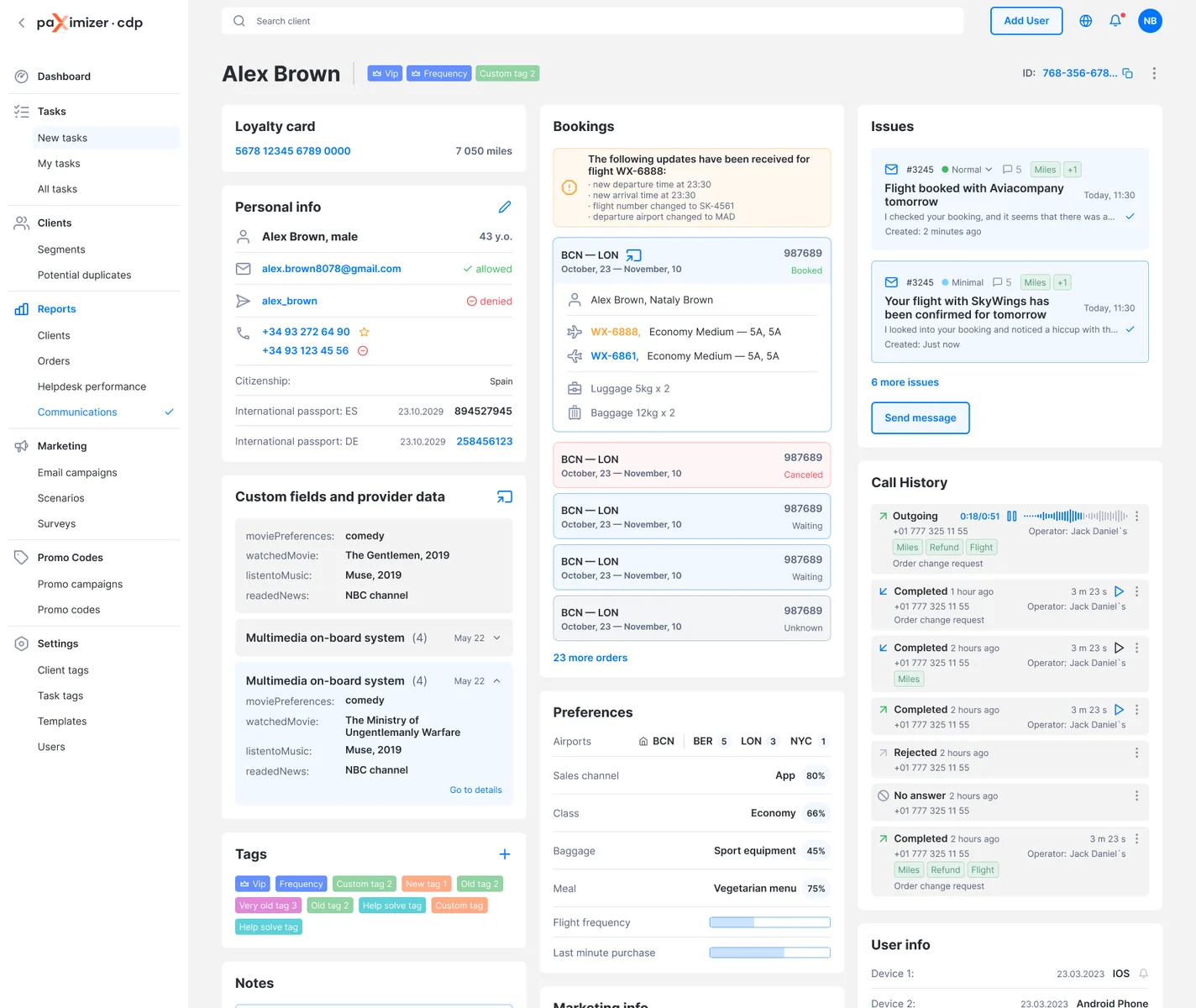
A customer data platform for airlines, designed in code instead of Figma. The usual way — a Figma mock-up, a handoff, weeks of building, manual testing — is replaced by a pipeline: research, an HTML prototype in two variants, my pick, then planner, coder, verifier and reviewer agents in Claude Code build it on the design system, and a tester skill walks every flow as a real client, role by role. In the last comparison it caught 70% of what a human tester found, and the human missed 80% of what it found. I lead the front-end architecture in a team of five: the structure, the design system — 96 components in three tiers, with Storybook as the reference — and the logic of every feature. About half of the front end came out of my sessions.
Made with Vue 3.5 · Vite 7 · TypeScript strict · Pinia · Storybook 8 · Vitest · Playwright e2e · Lighthouse CI · Laravel backend · Claude Code (5 agents · 13 skills)
How it was built
Screens are under NDA, so this is a schematic. Real screens on request.
Solo · design + build · 140 of 140 commits
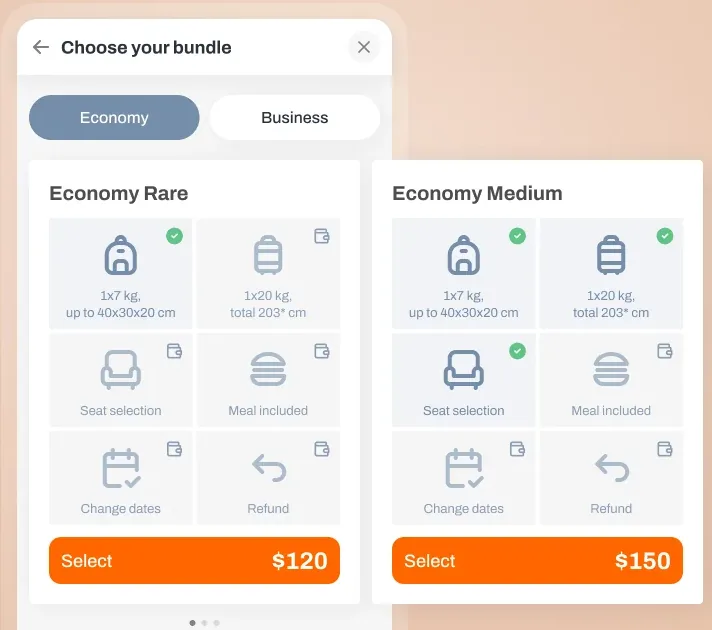
Styling a booking engine for a new airline used to take about a month of design and front-end work; here it is a day: components picked in the admin, the brand in one JSON. Airlines swap components quickly and test them — and raise conversion.
One booking engine for any airline, built by AI agents — a harness of 5 agents and 32 skills — without Figma, by one person. Where a new airline normally means a month of restyling, here each airline picks its components in the admin and its whole style is one JSON — a day's work. It began with research into competitor airlines, platforms and UX patterns. The front end talks to any airline's backend through one contract: it asks which of 28 capabilities the backend can serve and hides what it can't. The next step is the main idea: a front end that adapts to each passenger, composed from Paximizer CDP advice — the order of steps, the offers, the layout — with the total price always in view.
Made with Claude Code harness (5 agents · 32 skills) · Next.js 14 · React 18 · TypeScript strict · Radix + shadcn/ui · Tailwind · Zustand · Apollo GraphQL · next-intl (en/de/fr) · MSW · Vitest · Playwright · Storybook · Turborepo + pnpm
How it was built
8 live topics
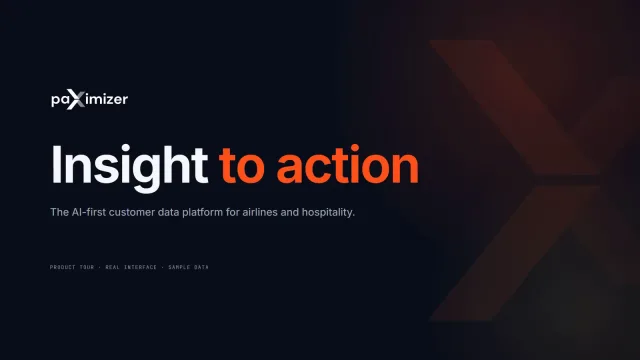
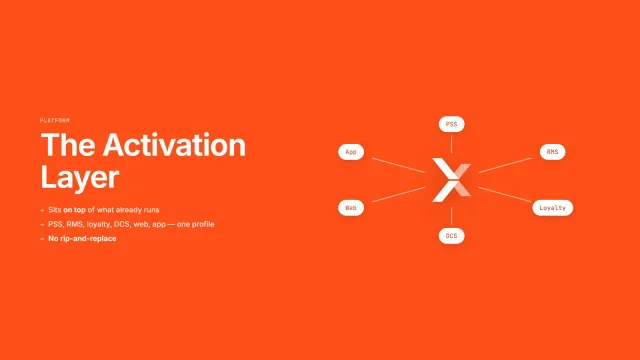
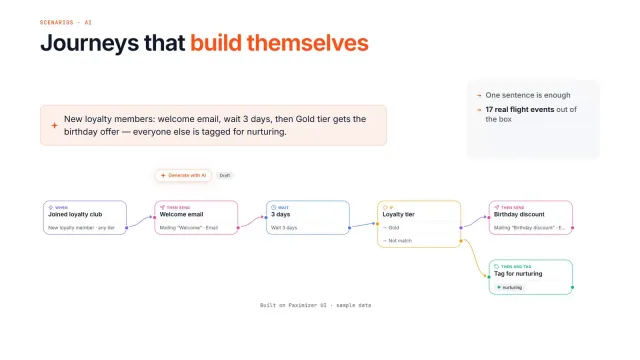
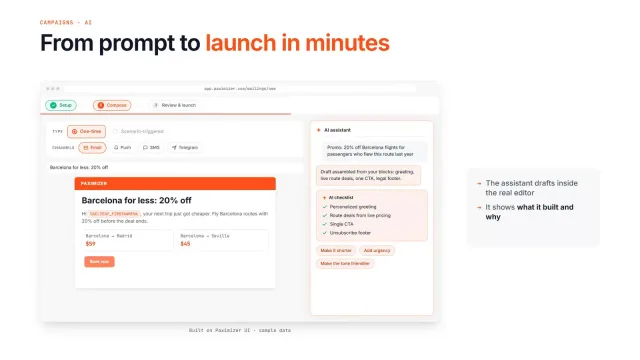
 2:34Post ready — approve?LinkedIn · X · Threads · Tue 09:0010:41
One sentence in, a whole journey out.
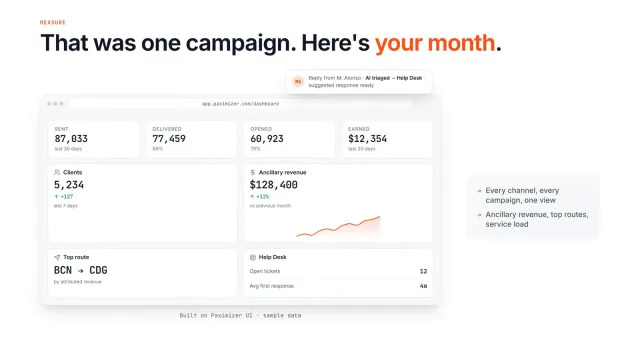
2:34From prompt to launch in minutes.
 Reel
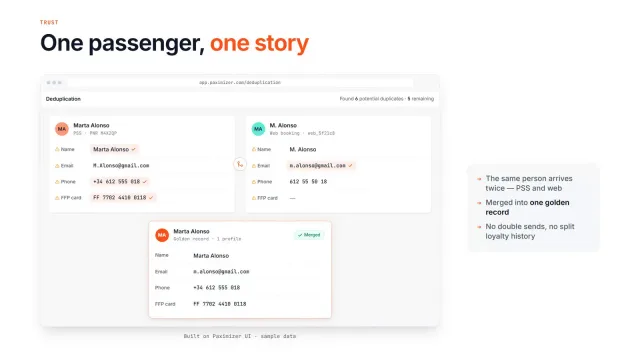
One passenger, one story — every system in one profile.
Product tour: a journey from one sentence
Design + build · 358 of 369 commits
Research, a content plan, decks, posts and narrated videos — a marketing department's weekly output — run themselves. A deck that took a designer days is ordered from the web admin or Telegram and generated on the server by an AI model in minutes.
A presentation and content studio that does the work of a marketing department: no designer drawing decks, no manager picking materials. Every week it researches what to post about and plans two weeks ahead, with briefs. Decks, posts, narration and video are built on one design system with templates and rules, voiced by a free local voice. A web admin runs it all — the calendar, decks, posts — and decks are generated on the server by an AI model; a Telegram bot handles approvals and urgent orders, minutes instead of days; published posts are cross-posted to paximizer.com.
Made with deck.json · HTML deck + slide screenshots · Kokoro-82M local TTS or Edge TTS · realtime capture → MP4 · self-contained publish · Telegram bot · web admin
How it was built
Idea
Plan your whole week
in one tap.
What they missNo product shown above the foldTwo CTAs compete for the click
The angleShow the week itself
Plan your whole week
in one tap.
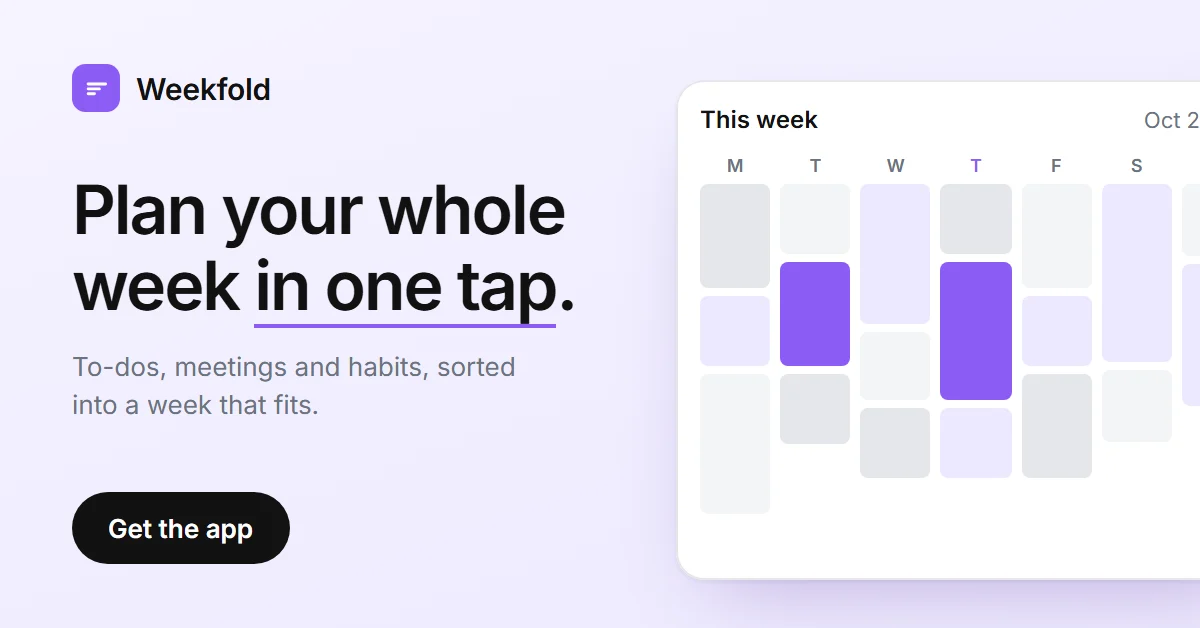
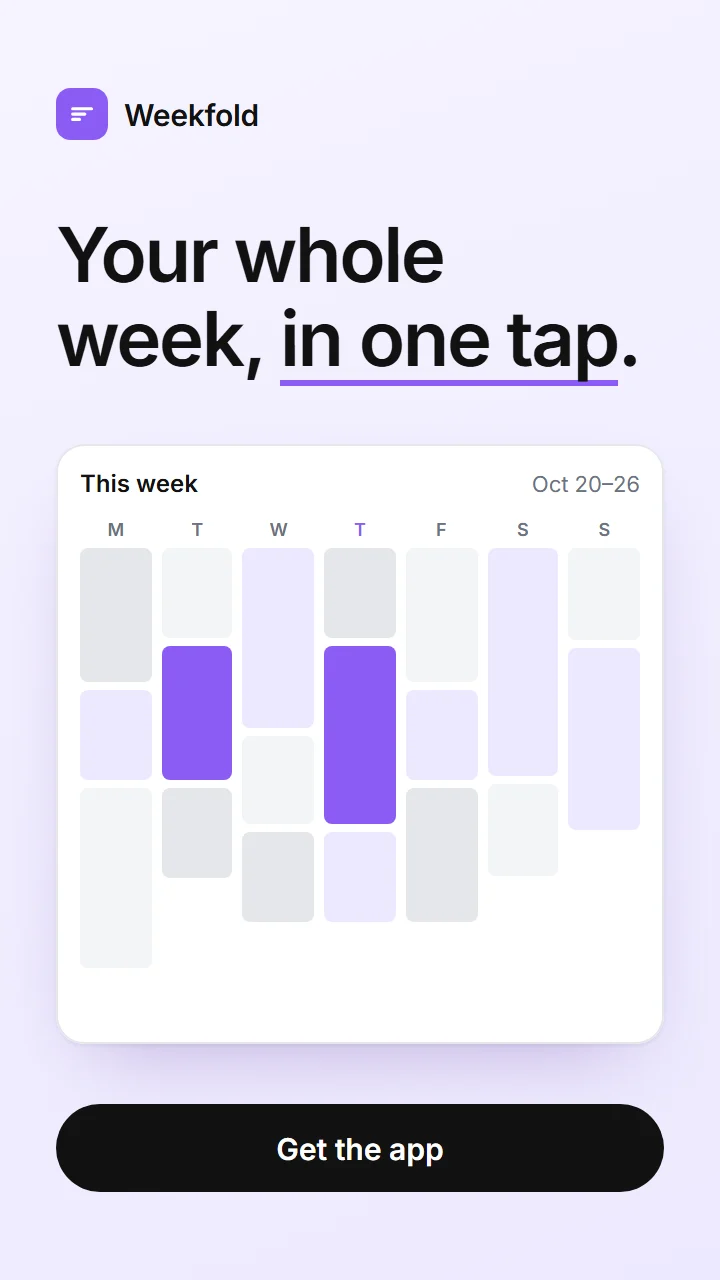
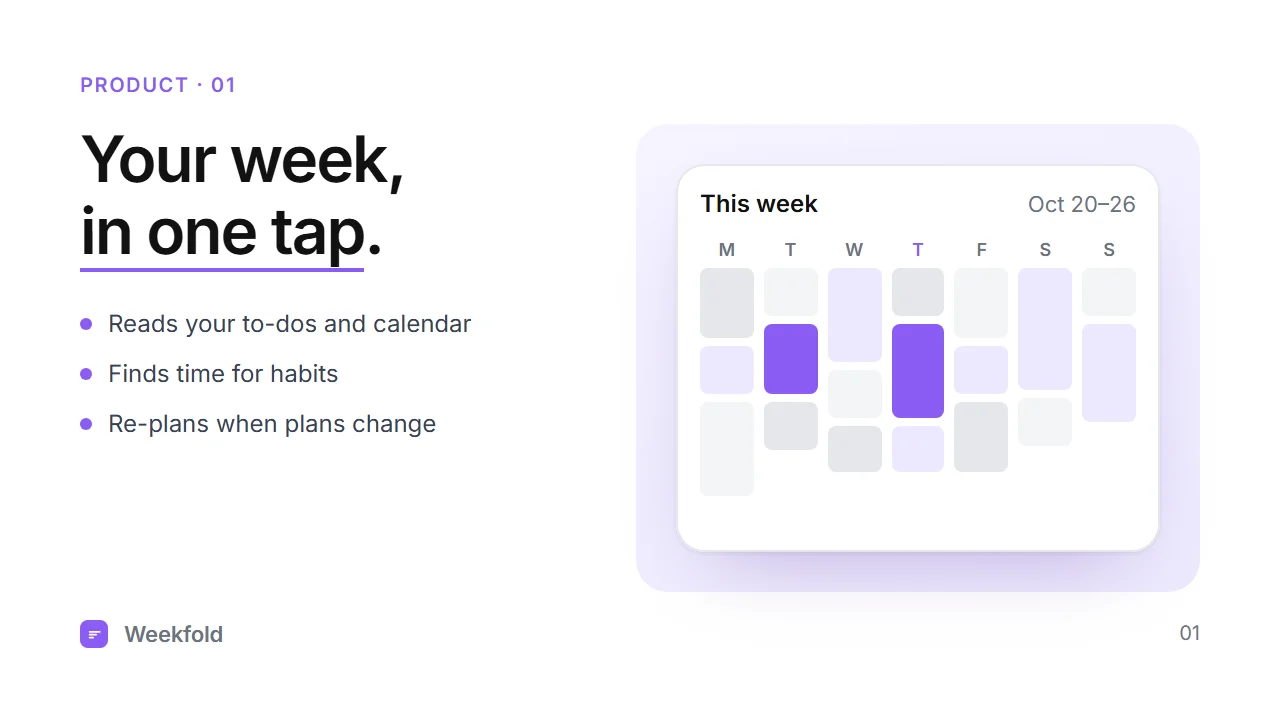
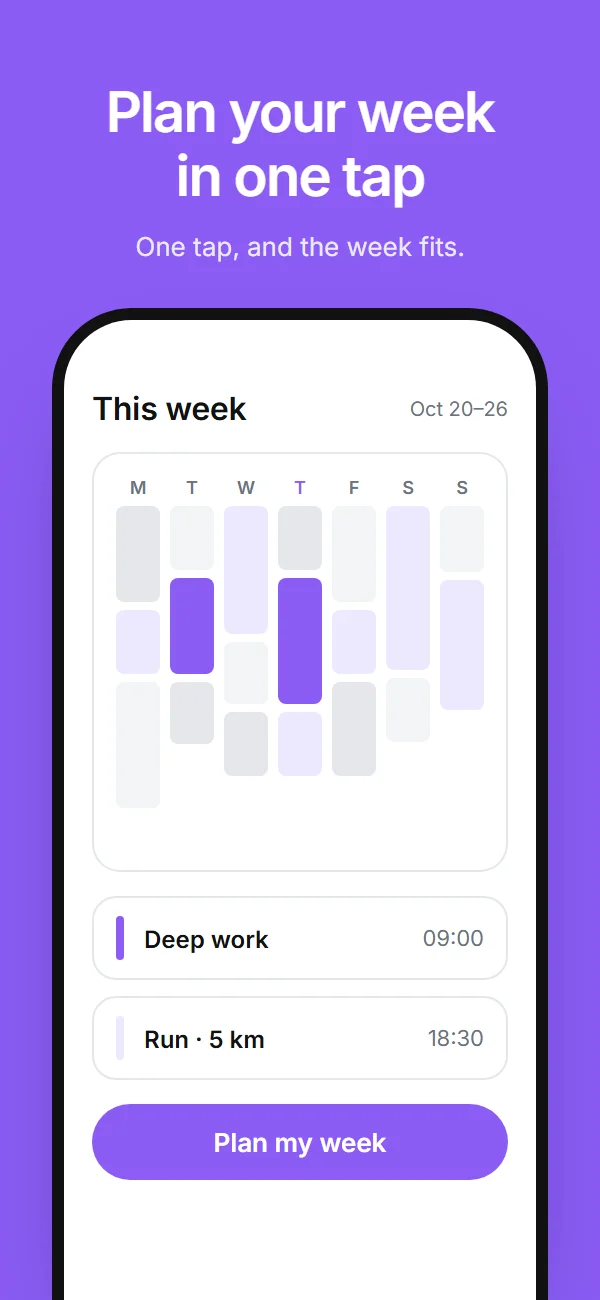
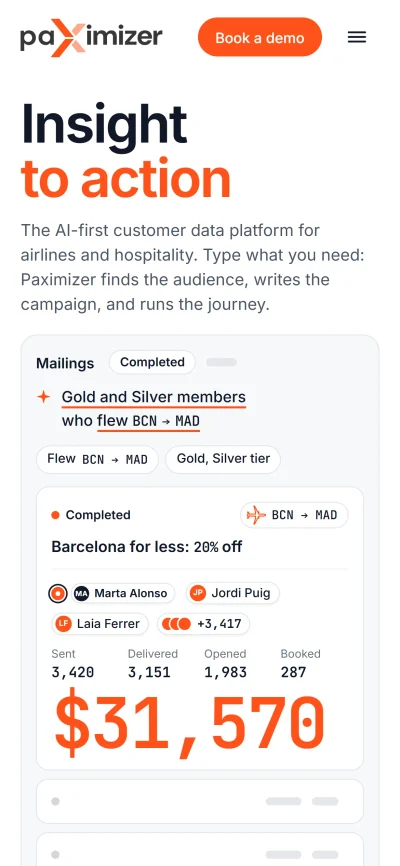
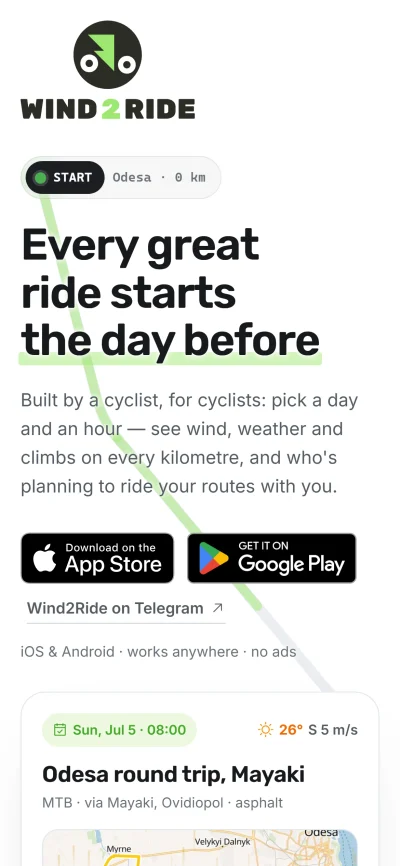
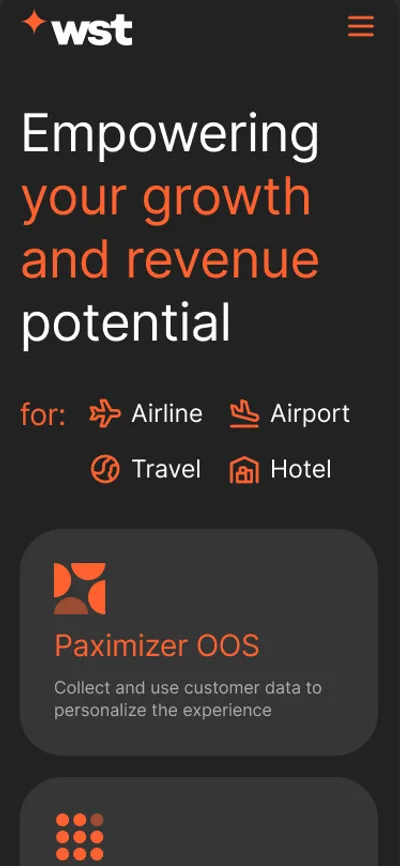
Design + build
The whole package — site, promo kit, sales materials — from one person instead of an agency or a marketing design team. paximizer.com left Webflow without a single broken link.
I package a product completely — the interface, the site and all the sales and promo materials — so no agency or marketing design team is needed. Each site starts with research — competitor sites side by side, what they say and what they miss — then wireframes, the design and the promo kit. paximizer.com replaced Webflow and kept all 91 legacy URLs, so not a single link broke; wind2ride.app carries route share pages, club invites and a video guide. Many more sites since 2010 are offline now or under NDA — I show them on request.
Made with Astro 5 + GSAP (paximizer.com) · HTML + Netlify functions (wind2ride.app) · Figma (WebSky Tech promo site)
How it was built
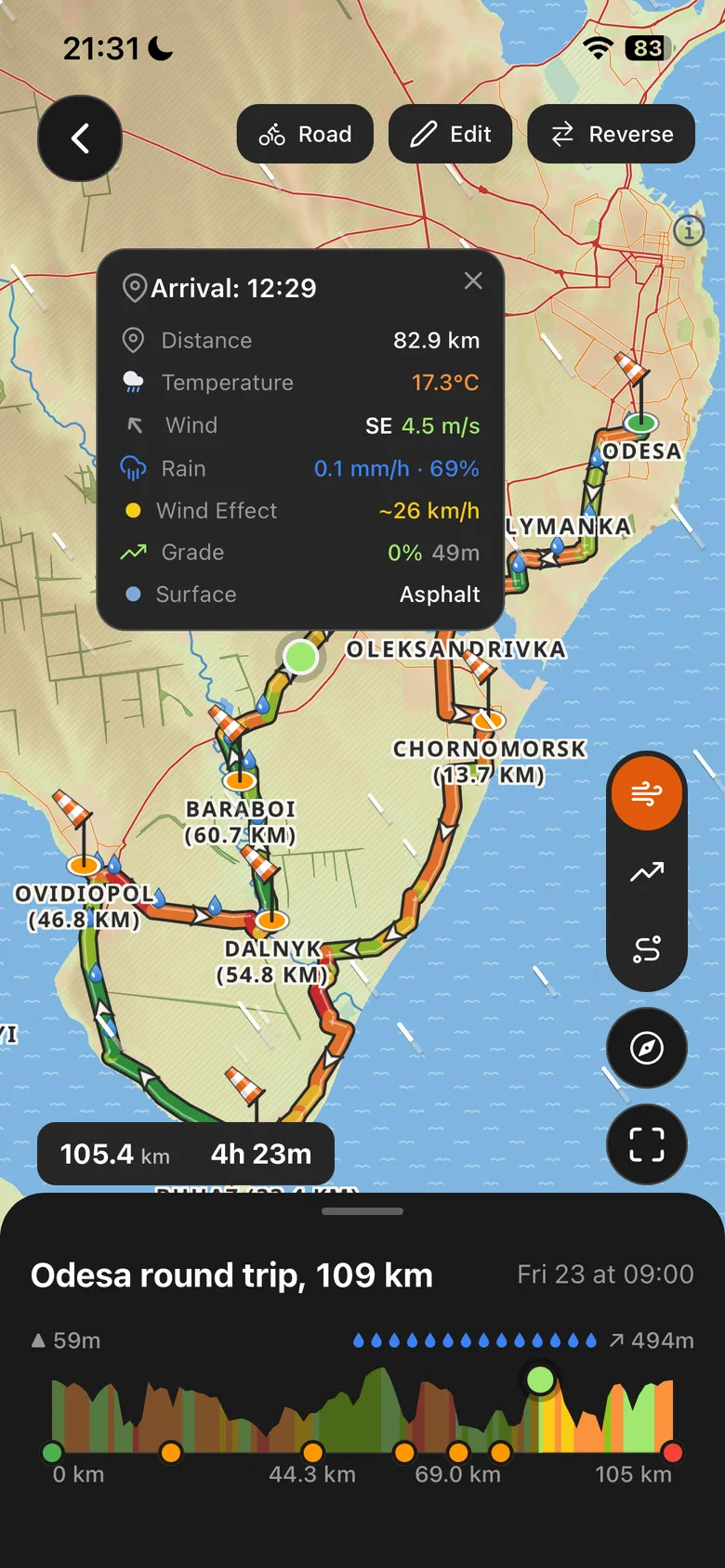
A route planner that reads the wind


Solo — from the idea to the store
Product, design, build, store release and support — a small product team's work, done by one person in spare time. 600+ riders so far.
I'm a cyclist, and I build an app for cyclists — alone, from the idea to the stores, doing what a small product team does: the product, the design, the build, the releases and the support. It began with a ride into a headwind and an analysis of how wind data can score a route, segment by segment. Riders tested it in a beta and reported from the app with screenshots; then came the social side — clubs and group rides. On Google Play, and on the App Store since summer 2026.
Made with React Native / Expo · TypeScript · 10 API integrations · 6 languages
How it was built
Tools · 8
Pax, how does the segment filter work?
Segments are groups of conditions: each picks a passenger property and a value; groups join with AND or OR.
Sources
Architect and author
A context generator for AI: any question about the product — a business rule or a line of code — answered in seconds instead of hours of digging. It cut the training of many colleagues to minutes and the tokens agents burn on context.
A knowledge base an AI can ask — a context generator. A question about the product that used to take hours of digging through old code and docs, or days of onboarding for a newcomer, is answered in seconds, from a business rule to a line of code. I documented the old front end and back end, indexed it into a RAG, and built an MCP server, so any AI agent could ask the project and get full context for any task.
Made with Node + TypeScript MCP server · FAISS embeddings (768-d) · RAG · MCP tools: kb_search, kb_search_code, kb_get_entity, kb_get_source, kb_get_hierarchy, kb_get_mock_data, kb_get_components_for_ui, kb_check_freshness
Lead Product Designer, WebSkyTech
Booking used by 20+ airlines. Tokens turned a new airline's branding from weeks of manual restyling into a token set applied in days; the redesigned flow added +5% conversion in an A/B test (preliminary).
A fully customizable booking engine for airlines — used by 20+ of them. Brand customization moved from manual restyling, weeks per airline, to design tokens applied in days. Research came first — airline constraints like PNR, SSR, fare rules and baggage — then the booking logic in wireframes, design tokens for multi-brand theming, the interface, tests on clickable Figma prototypes (+5% conversion in an A/B test, preliminary), and a handoff to the front-end team.
Made with Figma · design tokens · multi-brand theming
Product designer, MVP to production
Designed on real API models of four airline systems, so the front end was built once — no redesign loops when the data arrived. Six modules, MVP to production, one designer.
A customer data platform for airlines, designed in Figma and taken from MVP to production by one designer. The design rested on real API models from four airline systems, so the screens matched the data from the start and the front end was built once, without redesign loops. Most of the work was variants: every component drawn in several versions, tested against each other, the right one kept — across analytics, passenger profiles, loyalty, campaigns, support and monitoring, with roles, states and edge cases.
Made with Figma · real API models · roles and states
Lead Product Designer, WebSkyTech
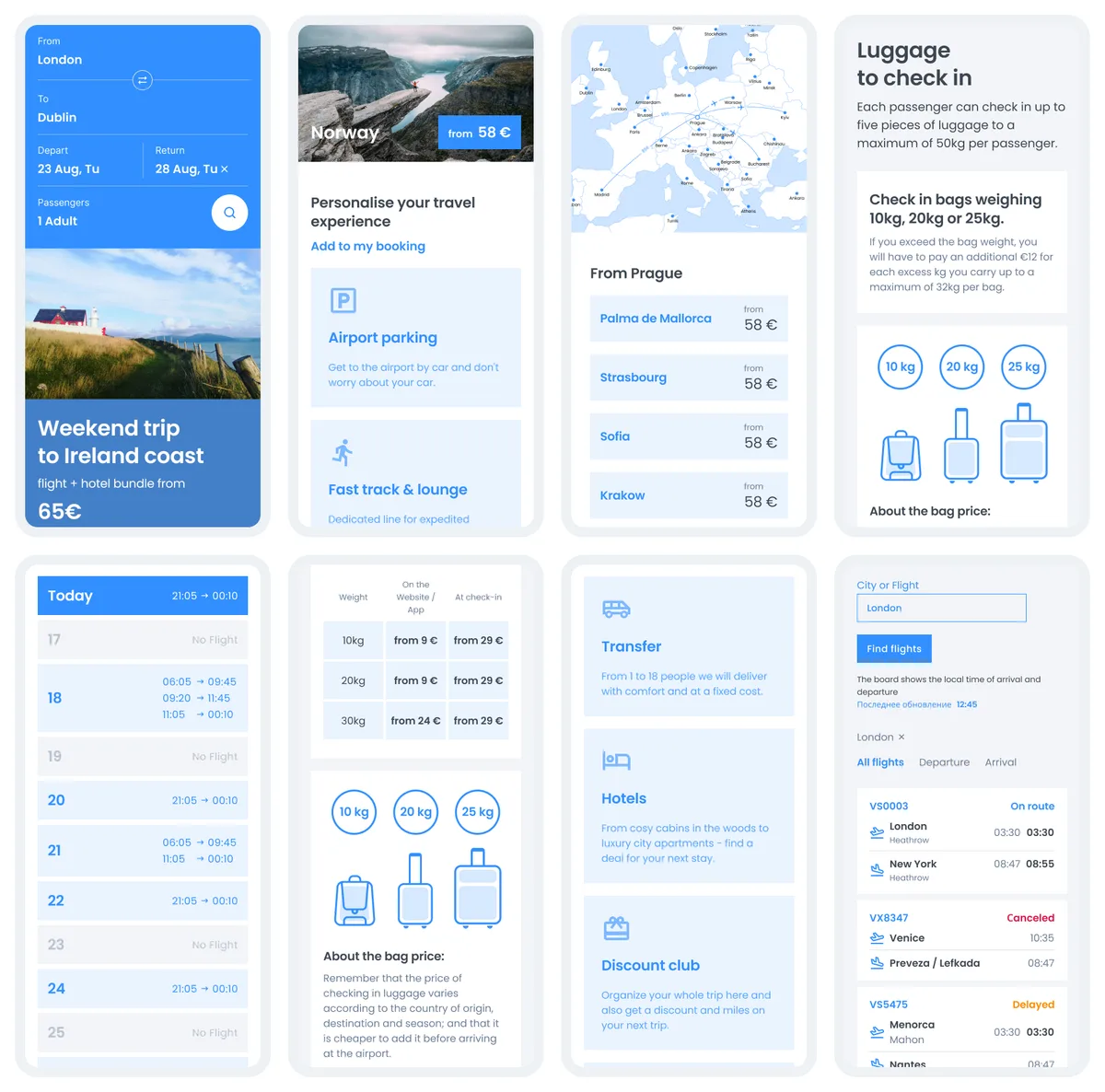
A constructor kit for airline websites: a site for any airline is assembled from block variants and styled to its brand in days, instead of a bespoke design project of weeks.
A constructor kit for airline websites — one template restyled for any airline (white label) — so a new airline's site is assembled in days instead of designed from scratch over weeks. Research into what every airline site needs, 20+ wireframe screens tested, semantic tokens with light and dark themes, a component library with variants — and a constructor: pick a variant of each block and the site assembles in the airline's brand.
Made with Figma · Notion · semantic tokens · light and dark themes
Windows app
A free app: work faster and learn English along the way. Select any text, press Ctrl+C twice, hear it in English with the translation. Offline: nothing leaves the computer.
How it was built
Work faster, learn English along the way
Free · Offline · Nothing leaves the computer
Claude Code skill
Finds an original design direction and builds it without breaking the design system. This page was designed with it. Open source.
How it works
Original design, inside the design system
Claude Code plugin + VS Code panel
Coding sessions become language lessons: my English, corrected and explained while I work. Built for my own English. Open source.
How it works
Coding sessions become English lessons
Figma plugin
One base colour gives full light and dark palettes, with an A11Y mode and export to Figma Variables.
How it works
One colour, two full palettes
Figma plugin
Spreads objects along any path or shape outline, with flexible spacing and rotation along the curve.
How it works
Objects follow any path
Built for my own work
Every tool takes a repeated manual step out of the day for good. Muse did a studio's design exploration for this page — 23 directions, a jury, 3 sketches — in one session instead of weeks.
I can automate any workflow, and every tool here removed a repeated manual step for good. When a step repeats, I first look for a tool that already does it, and build one when none fits: skills, plugins and apps for real, repeated work. Kryakl began as a tool for myself and grew into a free app my friends use. Muse, a Claude Code skill, designed this page the way a studio would, in one session: 23 directions, an independent jury, an idea board, 3 sketches.
Made with Windows app · Claude Code skill · Claude Code plugin · Figma plugins
Hard skills 06
I set up the harness — agents, skills, hooks, MCP servers, RAG — so the AI works by the project's rules.
I set the architecture, the structure and the checks; agents write the code (Vue, React Native, Astro).
Flows, scenarios, roles and states, down to the data model: how it works before how it looks.
Composition and typography; tokens, components and multi-brand theming, with Storybook as the reference.
Workflows, tasks and time: from self-built databases to Notion and trackers.
Soft skills 04
AI where it pays off; a ready-made engine (a free local voice), a script or a drawing where it doesn't; animation only where it explains something.
From the first question to the shipped thing.
A tutor for my English, a status bar for my limits, palettes for Figma — plugins and skills for my own repeated work.
Odesa, Ukraine. I've designed since 1997 — print, web, education platforms with millions of visitors, then airline products — and for the last few years I've been building the systems that do the design work: tokens, components, prototypes and the AI workflows that put them together.
I work remotely with product and engineering teams across time zones, in English, and I like owning a problem from the first question to the shipped thing.
English: B1 and rising — I practise every day with the plugin I built for it, Tutor ↗
I like prog-rock and ambient, bicycles and good design. Best when a hobby meets the job — that's how Wind2Ride began.
Wind2Ride is my fun project: a route planner for cyclists that reads the wind. I build it in my spare time — if you ride, give it a try.